Founder's letter · IDFA 2026 · by Guido van Staveren van Dijk, founder of Moyee
Every November I find myself back at IDFA (International Documentary Film Festival Amsterdam), and every November I think of one evening in 2008. The festival opened in Tuschinski with Episode III: Enjoy Poverty by Renzo Martens. Half the audience left the cinema feeling uneasy. And that is exactly why it mattered.
For those who don't know Moyee that well yet: that film inspired me to start the FairChain movement and Moyee Coffee. This blog is about how art can inspire business, and the other way around. It takes a few minutes to read, but you can also listen or watch. Enjoy…
Watch and listen: Moyee x Renzo Martens
Eighteen years later we sat down with Renzo for an IDFA edition of our vodcast. About art, plantations, Clooney and who gets to tell the story. Watch the full conversation, listen to the podcast or start with the reel.
A neon sign in the jungle
For two years Renzo travelled through the Democratic Republic of Congo, following aid workers, photographers and plantation owners. His provocation was simple and brutal: poverty is Congo's most valuable export, but the people who live it earn nothing from it. The images are sold elsewhere. The value goes elsewhere.
In the film, porters carry a neon sign deep into the forest. It lights up in the dark: ENJOY POVERTY, PLEASE. It's funny for a second. Then it isn't. As a viewer I realised I was part of the same machine. And the question the film left me with wasn't moral. It was economic.
Who owns the value that is created? That's not an art question. That's a business question.
From the cinema to the coffee chain
That question never let go of me. Inspired by the conversations with Renzo that followed, in 2011 and 2012 I started pulling apart international supply chains, and soon, cup by cup, the coffee chain, to see where the money really goes. Consumer prices kept rising while the farmer's share kept falling. Beans leave the country green and cheap. Roasting, packaging, branding and selling, where the real margin sits, all happen in the North. Fairtrade fixes the price of the bean with a minimum floor. Nobody was fixing the chain.
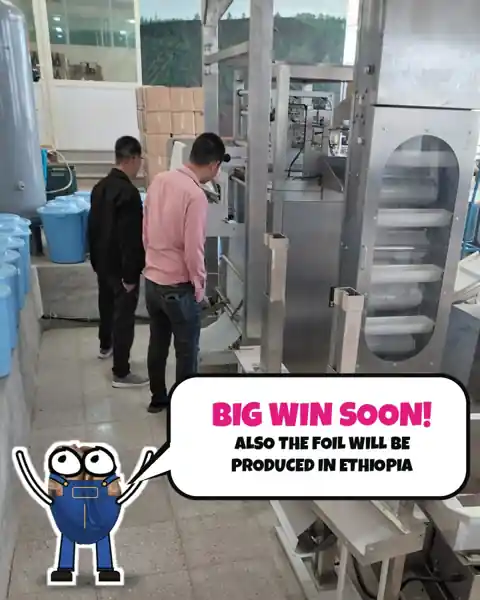
So I started the FairChain Foundation, and soon after, Moyee. Not to sell coffee, but to prove that a healthy business model can clean up mess instead of causing it. We launched a Wake Up campaign and invited everyone to help build The Future of Coffee: a world where everybody wins, based on radical equality and transparency. Our goal is to give the coffee chain a new blueprint, which is why we started roasting our coffee in Ethiopia, not Amsterdam. Jobs, skills and margin stay where the coffee grows. We call it FairChain, and it really all started with a film. With art!
Two projects, one logic
In 2012 Renzo founded the Institute for Human Activities on a former Unilever palm-oil plantation in Lusanga, Congo. I was honoured when he asked me to join its board, which was later chaired by Derk Sauer, who sadly passed away in 2025.
Plantation workers there founded their own art collective, CATPC. They model sculptures in river clay, which are cast in chocolate made from the very cocoa and palm oil the plantations extract. The sculptures sell in New York, Berlin and Basel, and the money buys back exhausted plantation land. In 2024 CATPC represented the Netherlands at the Venice Biennale. Today they have bought back about 400 hectares, and monoculture is turning back into forest.
Renzo used art to bring value back to the plantation. Moyee uses coffee to bring value back to the coffee-producing countries, so that development replaces aid.
You can copy the story. Not the impact.
“You're competing against companies that have far bigger firepower, who will copy your narrative as soon as they can without really doing the work.” — Renzo Martens
We see our slogans more and more often: on café windows, on wondrous packaging and on billboards. Flattering. We've always said we didn't start out to sell coffee, and that it takes hundreds of Moyees to bring about the change we're after. So copy away.
But it often stops at storytelling without proof. And real impact isn't a little more for a select group of farmers who grow quality coffee. Real impact is about the millions of coffee farmers living below the poverty line. AND about roasting in the country of origin. Work and income instead of development aid.
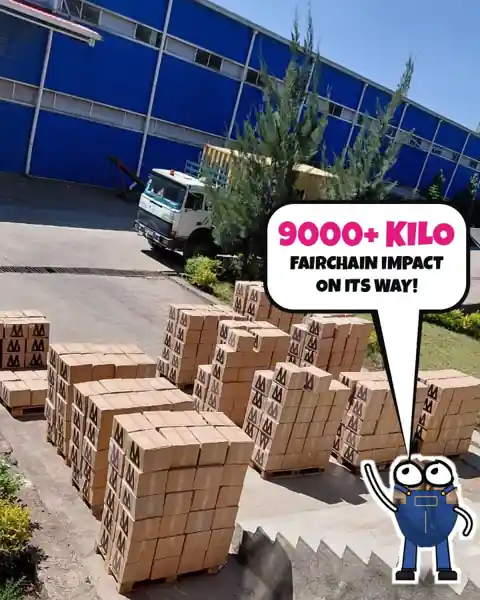
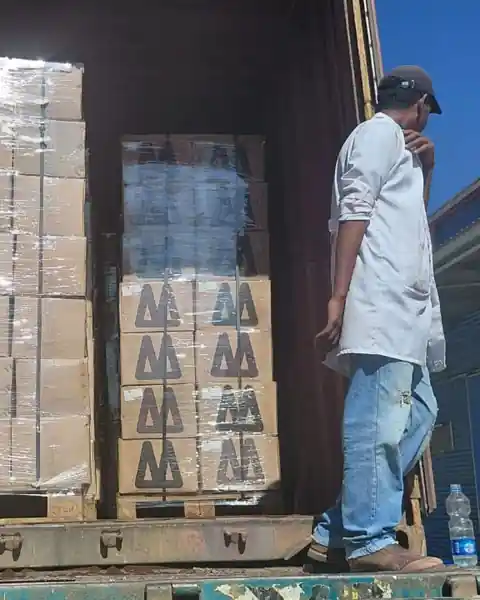
Until then, we just keep going. Look: another full load, ready to ship to a fast-growing army of Moyeestas who get that every cup of coffee is a revolutionary micro-habit. Every sip counts.
We don't do famous faces. We do crowdspeak.
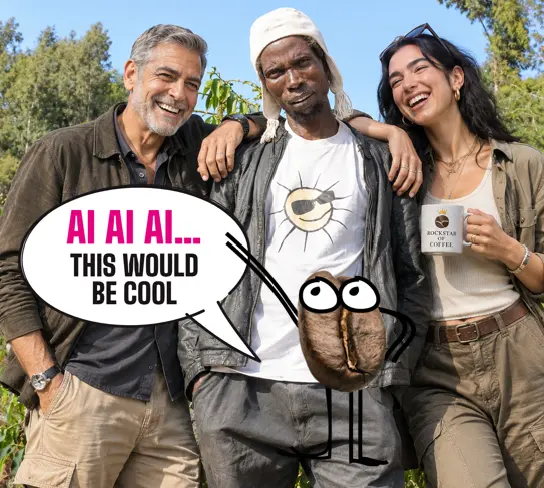
BigCoffee likes to work with a famous face. According to Renzo it's the wrong one: it hides the millions of anonymous farmers who do the real work. And it's the same mechanism as above. First their story was polished away behind a movie star, now it's taken by brands that use it to build a new impact front that mainly benefits themselves.
We focus on exactly those millions of farmers. With work and income, and with roasting in the country of origin.
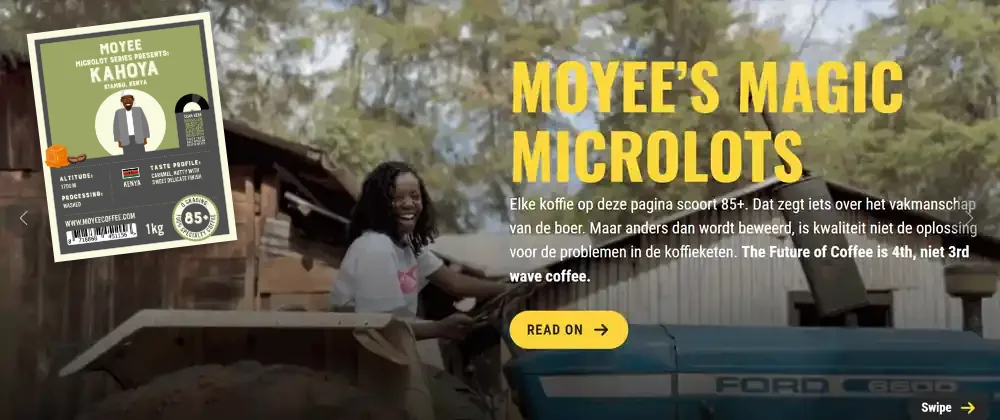
Still want to support a face? Then support this George: George Mbugua of Kahoya Farm in Kenya, one of the individual farmers we make our microlots with. At 1,700 metres he feeds the soil with homemade organic manure. The result: caramel, nutty notes and a sweet, soft finish. Roasted in Nairobi.
We don't make microlots because quality is the answer to the problems in the chain. It isn't. But because it shows that coffee is not a commodity you can sell at a premium with a famous face or a "borrowed" story, to the benefit of private equity or of coffee companies that did start out to sell coffee and are now filling in a new front for it, without doing the hard work and without proof of impact.
We don't spend our money on celebrities or billboards, but on you. So: 2+1 on Kahoya 250 grams. Two bags for you, and one to give to someone who doesn't know FairChain yet. Use code KAHOYA at checkout. Valid until 30 November. Gone is really gone.
Building other worlds
What we took from Renzo and CATPC: make the critique material. Use the system's own tools. Be uncomfortable on purpose. And let the people at the source co-own the story and the value that is created.
That is what we mean when we talk about The Future of Coffee and building other worlds, where everybody wins. Not a utopia on a billboard, but hectares of forest returning in Congo, and coffee in Ethiopia that pays more than cutting the trees. So we didn't start Moyee to sell coffee, but to put the FairChain principles into practice:
- Factories: the value stays where the coffee grows. We roast in Ethiopia and Kenya; in 2025, 57.2% of the value stayed in the country of origin, against around 10% in the conventional coffee chain.
- Farmers: no vague “fair price”, but at least a scientifically calculated price a farming family can live on: the Living Income Reference Price. In Ethiopia we paid on average 33% above that price in 2024/25.
- Forests: we reduce and capture CO₂ within our own chain, without bought offsets. In 2025, by our own calculation, the farms and trees in our chain absorbed around 3,400 tonnes of CO₂, against 600 tonnes of emissions. That calculation has not yet been independently verified.
- And you: specialty coffee without the price tag, and every number open to check.
That is how we see the future of coffee: a world where everybody wins, and where storytelling makes way for storyproving. All figures, with method and source, are live on our impact dashboard.
And mind you: FairChain is not a label. Come on, not yet another made-up sustainability label on a bag! The FairChain Foundation is a Dutch public-benefit foundation (ANBI) that supports any company that wants to make its impact measurable and verifiable. And we invite every company not to copy our copy, but our model.
Because yes, we're not building that world alone. Luckily you're already building it with us, with every bag, every cup and every time you tell someone about our FairChain model. Thank you.
Help buy back a hectare
CATPC’s work is on show at the Fondation Cartier in Paris until 28 February 2027. With the proceeds of their art, they buy back land in Lusanga. Let’s help them: visit the shop.
Eighteen years ago a film told me to enjoy poverty. I didn't. I hope you won't either.
Guido van Staveren van Dijk
Founder, Moyee · FairChain
Read more: Human Activities and CATPC · Enjoy Poverty in the IDFA archive · Taste George's Kahoya microlot